

Topiary is the horticultural practice of training of live perennial plants, by clipping the foliage and twigs of trees,shrubs and sub shrubs to develop and maintain clearly defined shapes, perhaps geometric or fanciful; and plants which have been shaped in this way. It can be an art and is a form of living sculpture. The word derives from the Latin word for an ornamental landscape gardener, topiarius, creator oftopia or "places", a Greek word that Romans applied also to fictive indoor landscapes executed in fresco. No doubt the use of a Greek word betokens the art's origins in the Hellenistic world that was influenced by Persia, for neither Classical Greece nor Republican Rome developed any sophisticated tradition of artful pleasure grounds.

Modern revival: traditional topiary again fills the squares of the parterre at the Château de Villandry, France.
The plants used in topiary are evergreen, mostly woody, have small leaves or needles, produce dense foliage, and have compact and/or columnar (e.g. fastigiate) growth habits. Common species choices used in topiary include cultivars of European box (Buxus sempervirens), arborvitae (Thuja spp.), bay laurel (Laurus nobilis), holly (Ilex spp.), myrtle (Eugeniaor Myrtus species), yew (Taxus species), and privet (Ligustrum species.). Shaped wire cages are sometimes employed in modern topiary to guide untutored shears, but traditional topiary depends on patience and a steady hand; small-leaved ivy can be used to cover a cage and give the look of topiary in a few months. The hedge is a simple form of topiary used to create boundaries, walls or screens.
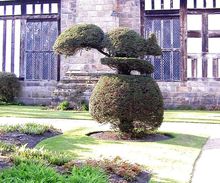
Squirrel topiary, Rufford Old Hall, Lancashire, England.
History
Origin
European topiary dates from Roman times. Pliny's Natural History and the epigram-writer Martial both credit Cneius Matius Calvena, in the circle of Julius Caesar, with introducing the first topiary to Roman gardens, andPliny the Younger describes in a letter the elaborate figures of animals, inscriptions and cyphers and obelisks in clipped greens at his Tuscan villa (Epistle vi, to Apollinaris). Within the atrium of a Roman house or villa, a place that had formerly been quite plain, the art of the topiarius produced a miniature landscape (topos) which might use the comparable art of stunting trees, also mentioned, disapprovingly, by Pliny (Historia Naturalis xii.6).Far Eastern topiary

Cloud-pruning in a private garden, Matsumoto, Nagano
Renaissance topiary

Topiary at Fingask Castle, Tayside. Second half C19th
From its European revival in the 16th century, topiary has historically been associated with both the parterres and terraces in gardens of the European elite and equally as features in cottage gardens. Traditional topiary forms use foliage pruned and/or trained into geometric shapes: balls or cubes, obelisks, pyramids, cones, tapering spirals, and the like. Representational forms depicting people, animals, and manmade objects have also been popular.
Topiary at Versailles and its imitators was never complicated: low hedges punctuated by potted trees trimmed as balls on standards, interrupted by obelisks at corners provided the vertical features of flat-patterned parterre gardens. Sculptural forms were provided by stone and lead sculptures. In Holland, however, the fashion was established for more complicated topiary designs; this Franco-Dutch garden style spread to England after 1660.
Decline in the 18th century

Levens Hall's Elizabethan Topiary in 1833
- The tower of Babel, not yet finished.
- St George in box; his arm scarce long enough, but will be in condition to stick the dragon by next April.
- A quickset hog, shot up into a porcupine, by its being forgot a week in rainy weather.
Revival

Beckley Park, Oxfordshire: cottage garden topiary formulas taken up for an early 20th century elite English garden in a historic house setting
The revival of topiary in English gardening parallels the revived "Jacobethan" taste in architecture; John Loudon in the 1840s was the first garden writer to express a sense of loss at the topiary that had been removed from English gardens. The art of topiary, with enclosed garden "rooms" burst upon the English gardening public with the matured example ofElvaston Castle, Derbyshire, which opened to public viewing in the 1850s and created a sensation: "within a few years architectural topiary was springing up all over the country (it took another 25 years before sculptural topiary began to become popular as well"). The following generation, represented by James Shirley Hibberd, rediscovered the charm of specimens as part of the mystique of the "Englishcottage garden", which was as much invented as revived from the 1870s:
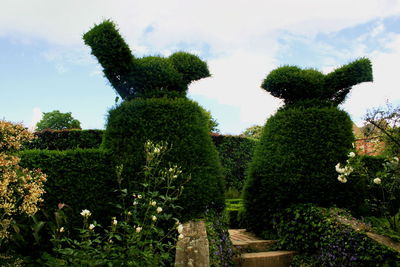 Topiary birds at Hidcote Manor Garden
The classic statement of the British Arts and Crafts revival of topiary among roses and mixed herbaceous borders, characterised generally as "the old-fashioned garden" or the "Dutch garden" was Topiary: Garden Craftsmanship in Yew and Box by Nathaniel Lloyd (1867-1933), who had retired in middle age and taken up architectural design under the encouragement of Sir Edwin Lutyens: Lloyd's own timber-framed manor house, Great Dixter, Sussex, remains an epitome of this stylized mix of topiary with "cottagey" plantings that was practised by Gertrude Jekyll and Edwin Lutyens in a fruitful partnership. The new gardening vocabulary incorporating topiary required little expensive restructuring in plan: "At Lyme Park, Cheshire, the garden went from being an Italian garden to being a Dutch garden without any change actually taking place on the ground," Brent Elliot noted in 2000.It may be true, as I believe it is, that the natural form of a tree is the most beautiful possible for that tree, but it may happen that we do not want the most beautiful form, but one of our own designing, and expressive of our ingenuity—(James Shirley Hibberd).
Americans in England were awake to the renewed charms of topiary. When William Waldorf Astor bought Hever Castle, Kent ca 1906, the moat surrounding the house precluded adding wings for servants, guests and the servants of guests that the Astor manner required: he built an authentically-style Tudor village to accommodate the overflow, with an "Old English Garden" including buttressed hedges and free-standing topiary. In the preceding decade, expatriate Americans, led by Edwin Austin Abbey, created an Anglo-American society atBroadway, Worcestershire, where topiary was one of the elements of a "Cotswold" house-and-garden style soon naturalized among upper-class Americans at home. Topiary, which had featured in very few eighteenth-century American gardens, came into favour with the Colonial Revival gardens and the grand manner of the American Renaissance, 1880–1920. The beginning of a concern with the revival and maintenance of historic gardens in the 20th century led to the replanting of the topiary maze at the Governor's Palace, Colonial Williamsburg, in the 1930s.
The title character in Tim Burton's movie Edward Scissorhands is lauded for his skill in the art; a real-life topiary artist is one of the subjects of Errol Morris's Fast, Cheap and Out of Control.
20th century

An eccentric topiary bird on a hedge in a country lane near Holywood, Dumfries, Scotland.
Artificial topiary are another off-shoot similar to the concept of artificial Christmas trees. These topiary mimic the same style of living versions, often as indoor plants for home decoration. Patents are issued as well in both style, design, and concept on the construction of different types of topiary trees.American Portable style Topiary was introduced to Disneyland around 1962. Walt Disney helped bring this new medium into being - wishing to recreate his cartoon characters throughout his theme park in landscape shrubbery. The frame allows the plants to grow into every curve with a built in guide. This style of topiary is based on a steel wire frame that is either stuffed with sphagnum moss and planted, or a frame that has shrubbery growing from within as a permanent cutting guide. The sculpture slowly transforms into a permanent topiary then as it grows in. This style has led to imaginative displays and festivals throughout theDisney Resorts and Parks, and Mosaiculture (multiple types and styles of plants creating a mosaic, living sculpture) competition worldwide includes the impressive display at the 2008 Summer Olympics in China. Living corporate logos along roadsides, green roof softscapes and living walls that biofilter air are offshoots of this technology.
Notable topiary displays
Australia
A topiary at Railton, Town of Topiary, Tasmania, Australia


Topiary elephants at Bang Pa-In Royal Palac

Topiary at Parque Francisco Alvarado, Zarcero, Costa Rica
- Railton, Tasmania known as Railton Town of Topiary (Railton, Tasmania)
- Railton is a part of the Kentish Municipality, Tasmania's "Outdoor Art Gallery". Railton's topiary is one facet of the outdoor art gallery. There are many topiaries underway in various stages of growth.
Asia
- Mosaiculture 2006 (Shanghai, China)
- The Samban-Lei Sekpil in Manipur, India, begun in 1983 and recently measuring 18.6 m (61 ft) in height, is the world's tallest topiary, according to Guinness Book of World Records. It is clipped of Duranta erecta, a shrub widely used in Manipuri gardens, into a tiered shape called a sekpil or satra that honours the forest god Umang Lai.
- Royal Palace at Bang Pa-In in Thailand

Central America
A garden in Tours, France. Free-standing topiary balls tend to develop into gumdrop
- Parque Francisco Alvarado, Zarcero, Costa Rica
Europe

A topiary dinosaur at Epcot
- Cliveden (Buckinghamshire, England)
- Levens Hall (Cumbria, England)
- A premier topiary garden started in the late 17th century by M. Beaumont, a French gardener who laid out the gardens of Hampton Court (which were recreated in the 1980s).
- Topsham railway station (Devon, England) An example of topiary lettering.
- Canons Ashby (Northamptonshire, England) A 16th-century garden revised in 1708
- Stiffkey, (Norfolk, England)
- Several informal designs including a line of elephants at Nellie's cottage and a guitar.
- Hidcote Manor Garden (Gloucestershire, England)
- Knightshayes Court (Devon, England)
- Great Dixter Gardens (East Sussex, England): Laid out by Nathaniel Lloyd, the author of a book on topiary, and preserved and extended by his son, the garden-writer Christopher Lloyd.
- Much Wenlock Priory, Shropshire
- Drummond Castle Gardens (Perthshire, Scotland)
- Portmeirion (Snowdonia, Wales)
- Parc des Topiares (Durbuy, Belgium)
- A large topiary garden (10 000 m2) with over 250 figures.
- Château de Villandry, France
- Villa Lante (Bagnaia, Italy)
- Castello Balduino (Montalto Pavese, Italy)
- Guggenheim Museum, (Bilbao, Spain): A huge sculpture of a West Highland White Terrier designed by the artist Jeff Koons, which is thought by experts and scientists to be the world's biggest topiary dog.
- The Tsubo-en Zen garden in Lelystad, Netherlands is a private Modern Japanese Zen (karesansui, dry rock) garden that makes extensive use of so called O-karikomi combined with Hako-zukuri (see below).

All seasons close-up of the Tsubo-en (Netherlands) O-karikomi, hako-zukuri topiary.
North America
- Hunnewell Arboretum (Wellesley, Massachusetts)
- 140-year-old topiary garden of native white pine and arborvitae.
- Ladew Topiary Gardens (Monkton, Maryland)
- A topiary garden in Maryland established by award-winning topiary artist Harvey Ladew in the late 1930s. Located approximately halfway between the north Baltimore suburbs and the southern Pennsylvania border. Ladew's most famous topiary is a hunt, horses, riders, dogs and the fox, clearing a well-clipped hedge, the most famous single piece of classical topiary in North America.
- Topiary Garden at Longwood Gardens (Kennett Square, Pennsylvania)
- Columbus Topiary Park at Old Deaf School (Columbus, Ohio)
- A public garden in downtown Columbus that features a topiary tableau of Georges Seurat's famous paintingSunday Afternoon on the Island of La Grande Jatte
- Pearl Fryar's Topiary Garden, (Bishopville, South Carolina)
- Green Animals, a topiary garden outside Providence, Rhode Island. One of the subjects of the documentary Fast, Cheap and Out of Control (1997) was George Mendonça, the topiarist at Green Animals for more than seventy years: "it's just cut and wait, cut and wait" Mendonça says in a filmed sequence..

 Make some of your own topiary frames
How to Make Your Own Topiary
Outdoor topiary can create a striking effect in your garden. Taking the time to make your own topiary can save you up to several hundred dollars as well as give you a gardening focal point that you can be proud of.
There are essentially two kinds of topiary. There are vine topiary, where vines are encouraged to grow over topiary forms. Then there is shrub topiary, where a shrub is cut into a form.

There are essentially two kinds of topiary. There are vine topiary, where vines are encouraged to grow over topiary forms. Then there is shrub topiary, where a shrub is cut into a form.
Who doesn't love a pretty topiary, they can add a custom touch to your room design, be it French Country, Tuscan or for a pretty accent wherever you need a special touch.
Instructions
1
Mix the Plaster of Paris and pour into your container. Fill to 1" of the top of container. Add the branch and either hold till the plaster sets up, which is fairly quick, or tape the branch so it stands upright. Next, take the Styrofoam ball and push down on top of the stem so that 3" of the stem is inserted into the ball. Remove the ball and add a large dollop of hot glue to the top of the branch and replace the ball. Add glue to the surface of the Plaster of Paris and add the moss to cover the entire area.
Things You'll Need:
- Container w/o drain hole
- Plaster of Paris
- 16"Long, 1" thick branch for stem
- Styrofoam ball - 6-8"
- Silk flowers, leaves or your choice of vines or dried seedpods
- Dried moss

- DON'T MAKE YOUR FLOWERS/LEAVES TOO PERFECT, BE NATURAL

2 If you are going to cover the ball with silk flowers and leaves, you will need to remove these from the stem. Cut all but 1" of the stem from the parts you want to use and add a good drop of hot glue to the tip and push down into the styrofoam. Place your items so that each flower is surrounded by a group of leaves. Continue all around the ball until you are happy with the look.
3

GROW SOME VINES OUT OF YOUR CONTAINER
You may like how your topiary looks at this point or you could continue to add items. I glued a few pieces of silk vine to look as though it were growing out of the pot. Remember, this is your creation, make how you want it but do try and give it a natural look. If you don't care for the flower look, use dried items like the seed pods, tiny pinecones, small lichen covered branches or pieces of interesting bark. Let your decor decide how your topiary should look.
Tips & Warnings
- The style of the container is what sets the tone for the topiary. You may want to use metal, clay or even ceramic. You could use a basket although you'll want to pour your plaster into a metal can that can be inserted into the basket.
- Mixing the plaster can be messy. Work on newspaper and have a wet rag nearby to wipe any plaster off your container that may drip.
